
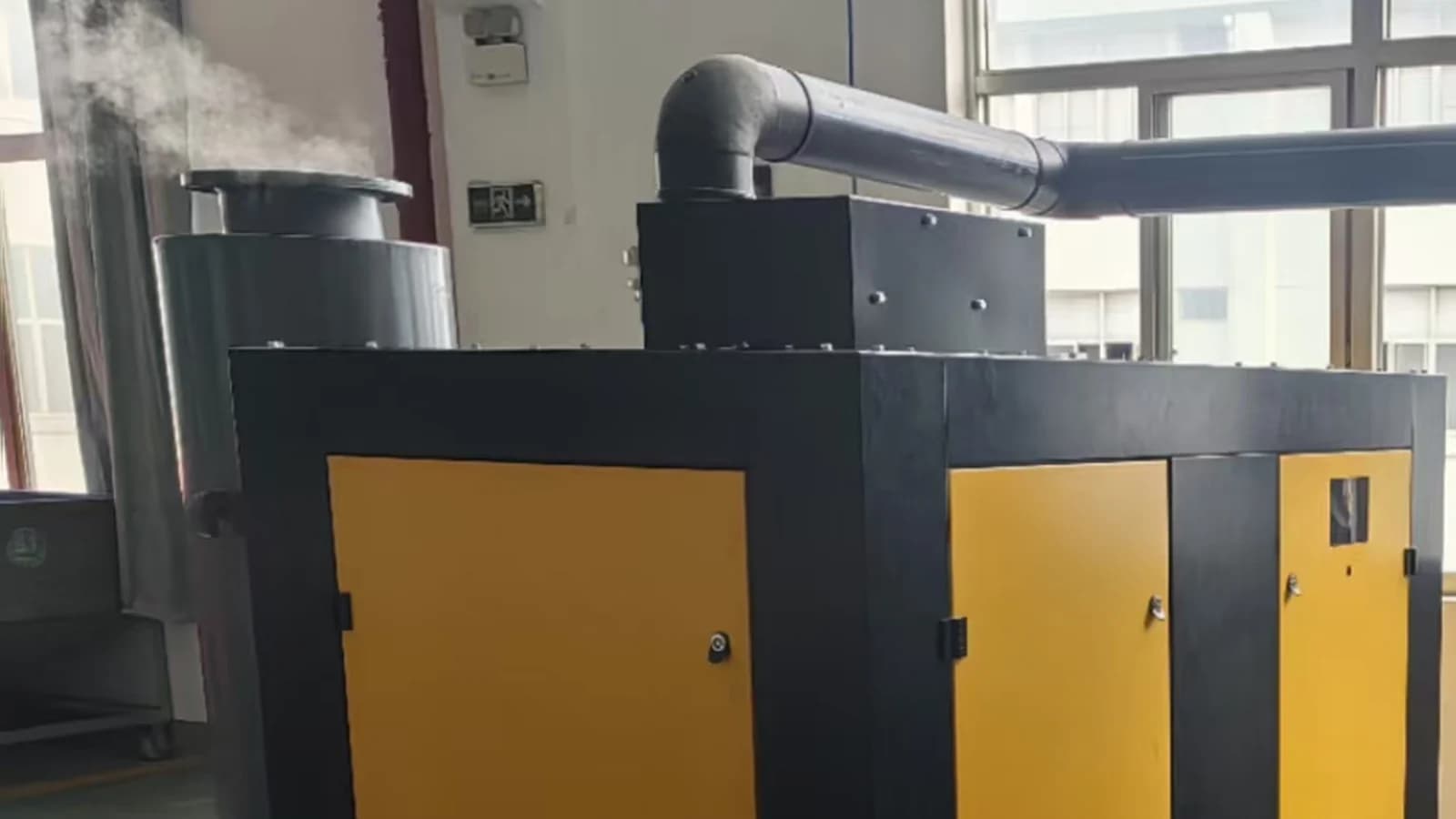
- For plastic thermoforming vacuum pump selection, start with the pressure or pressure range and required volumetric flow rate.
- After the first operating point is clear, review cycle time, recovery time, mold volume, leakage, line size, and the current pump setup.
- In the confirmed SC customer-site reference, the pump reached the required pressure within the specified time while meeting the customer's required volumetric flow rate.
- Use the TF105 case as a reference point for one thermoforming duty; another factory still needs its own pressure, required volumetric flow rate, cycle time, leakage, and site layout checked.
- A dry screw vacuum pump may be worth reviewing when the process gas should avoid service-liquid contact, or when the factory needs to compare power consumption at the required working vacuum and required volumetric flow rate.
Where vacuum is used in plastic thermoforming
In plastic thermoforming, the heated sheet has to contact the mold surface quickly and evenly. Vacuum removes the trapped air between the sheet and the mold, so the material can pull down into the shape before it cools too far.
For pump selection, this vacuum duty is usually easier to review in three parts:
| Thermoforming vacuum step | What the pump system needs to do |
|---|---|
| Pull-down vacuum | Remove air quickly after the heated sheet reaches the mold |
| Holding during forming | Keep enough vacuum for the formed part to stabilize before release |
| Cycle recovery | Recover the vacuum level again before the next forming cycle |
The pump label and nominal capacity are only a starting point. A thermoforming line needs enough usable vacuum capacity during repeated cycles, including pull-down, holding, leakage allowance, and recovery before the next sheet is formed.
Why cycle recovery matters more than a simple pump label
In many plastic thermoforming projects, ultimate vacuum is only one part of the review. The more practical question is whether the system can remove the air load within the cycle time and return to the required vacuum level before the next forming step.
In the confirmed customer-site reference available to SC Air Power Tech, the main duty was fast air removal and repeatable recovery during production. The same model logic should still be checked against each factory's mold design, sheet material, leakage condition, pipe layout, and production rhythm.
The pump review can change when these conditions change:
| Selection factor | Why it matters in thermoforming |
|---|---|
| Mold volume | A larger mold cavity can require more air removal during each cycle |
| Leakage and sealing condition | Leakage increases the air load the pump must handle |
| Line size and layout | Long or narrow lines can slow down response at the mold |
| Valve timing | Vacuum response depends on when the line opens and closes during the cycle |
| Cycle time | A shorter cycle leaves less time for pull-down and recovery |
| Current pump setup | Existing performance helps frame whether the new system must replace, support, or upgrade the old arrangement |
For a new production line, these items help estimate the required volumetric flow rate at the working pressure. For a running factory, the existing process often shows whether the current vacuum capacity is enough, where recovery slows down, and whether the new pump system needs to replace, support, or upgrade the current arrangement.
Start the RFQ with pressure and required volumetric flow rate
For the first RFQ, send the pressure or pressure range and the required volumetric flow rate. These two values are enough to begin a plastic thermoforming vacuum pump review.
With that operating point in place, the follow-up review can check whether the pump package can support the production cycle, recovery time, and vacuum response at the mold.
| First RFQ data | Helpful follow-up information |
|---|---|
| Pressure or pressure range | Mold size or mold volume, if known |
| Required volumetric flow rate | Cycle time and recovery time |
| Existing pump model, if available | Leakage or sealing condition |
| Current process issue, if known | Line size and layout |
| Contact details | Operating hours and start-stop pattern |
| — | Existing pump group or replacement target |
The follow-up items are optional for the first message. They become useful when the review moves from the first operating point to cycle behavior and site layout.
For an existing line, the current pump model and site photos can be useful. A known model gives an approximate performance range, and the review then checks it against pressure, required volumetric flow rate, and cycle behavior.
For more background on the first RFQ data, see What information is needed before requesting a dry screw vacuum pump quote?.
TF105 plastic thermoforming reference
SC Air Power Tech has a confirmed customer-site reference for one plastic thermoforming line using a TF105 dry screw vacuum pump. The useful point is that the pump was checked against production-cycle performance, including vacuum response and recovery under operating conditions.
The customer's required operating point was 17.8 m3/min at 40000 Pa(a). One dry screw vacuum pump was then tested for 24 hours on the same production line and under the same operating conditions.
| Customer-site comparison item | Confirmed reference |
|---|---|
| Required operating point | 17.8 m3/min at 40000 Pa(a) |
| Test setup | One dry screw vacuum pump used for a 24-hour production comparison |
| Original setup power consumption | 354 kWh during the 24-hour test |
| SC dry screw vacuum pump power consumption | 212 kWh during the 24-hour test |
| Process result | The SC dry screw vacuum pump reached the required pressure within the specified time while meeting the customer's required volumetric flow rate |
| Project outcome | The SC system will be used in the customer's new expansion line |
The factory already had 26 water ring vacuum pump systems, and those systems were not all damaged. The practical project path was to use the SC dry screw vacuum pump system for the customer's new expansion line, rather than replace every existing unit at once.
For a similar thermoforming duty, this reference can help frame the first RFQ discussion. A separate review should still check the buyer's pressure, required volumetric flow rate, cycle time, leakage, and site layout before applying the same model or power consumption comparison.
For the full case context, see TF105 dry screw vacuum pump for a plastic thermoforming line.
When a dry screw vacuum pump may be worth reviewing
A dry screw vacuum pump may be worth reviewing when the process gas should stay free from service-liquid contact inside the pump working chamber. In this configuration, water or oil is not introduced into the working chamber, so the pump does not add liquid contamination to the process gas stream. If the exhaust gas contains no harmful components and the local discharge rules allow it, direct atmospheric discharge can be reviewed.
This is also worth checking when the factory has strict power consumption requirements. If the dry screw pump can meet the required working vacuum and required volumetric flow rate, it is often compared with a water ring system for power consumption, especially on production lines with repeated forming cycles.
Dry screw technology is still not a one-model answer for every thermoforming machine. The review should check actual pressure, required volumetric flow rate, cycle time, leakage, piping, operating schedule, gas condition, and discharge requirement before confirming the pump package.