
A Field Engineer’s Diagnostic on Efficiency Losses and Maintenance Traps
Liquid ring vacuum pumps have been widely used in industry for decades because of their simple structure and ability to handle wet or contaminated gases. However, many factories are now facing rising electricity costs, stricter wastewater regulations, and increasing pressure to reduce utility consumption. In continuous production lines, the high water usage of liquid ring vacuum systems, combined with efficiency losses caused by operating water temperature changes, can significantly increase operating costs. As a result, more plants are beginning to replace liquid ring pumps with dry screw vacuum pumps to achieve lower utility consumption and more stable vacuum performance.
High Energy Consumption: From Constant Water Circulation
The continuous circulation of sealing water inside a liquid ring vacuum pump creates significant hydraulic losses. Because of this design, liquid ring pumps typically operate at much lower mechanical efficiency than dry screw vacuum pumps, especially in continuous-duty applications.
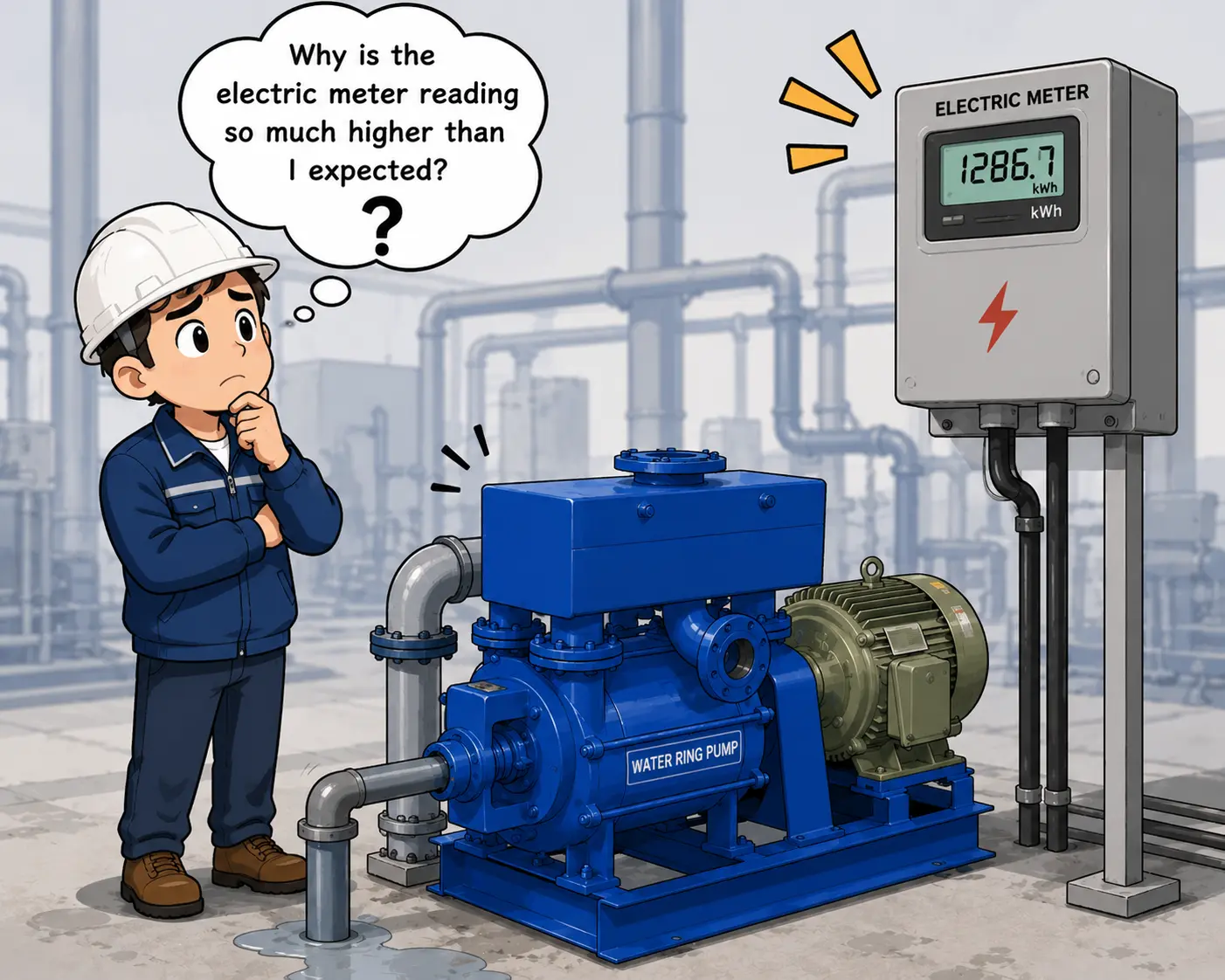
On paper, liquid ring pumps seem extremely reliable because the impeller is the only major moving component. But in actual plant operation, the motor is not only handling process gas — it is also continuously rotating a large volume of water inside the casing.
From what I’ve seen in the field, the amount of power lost to internal water movement can be surprisingly high, commonly around 40%. Once you add the cooling water pumps, cooling tower fans, and water treatment systems required to support the unit, the total system energy consumption increases even further.
I’ve reviewed projects where replacing a large liquid ring system with a dry screw vacuum pump reduced total power consumption by 10% to 50% under the same operating conditions. Over several years of continuous production, that difference becomes a major operating cost rather than a small utility expense.
Liquid ring vacuum pumps are more energy-efficient than dry screw vacuum pumpsFalse
Liquid ring pumps require the motor to continuously rotate and accelerate a large volume of sealing water inside the casing. This creates significant internal hydraulic losses and increases overall power consumption, especially during continuous operation. In many industrial applications, dry screw vacuum pumps achieve lower long-term energy consumption under the same operating conditions.
Key takeaway: Although liquid ring pumps have a simple and reliable mechanical design, they can consume far more power than many users expect because of the continuous movement of sealing water inside the pump. When evaluating replacement projects, it is important to compare the actual long-term electricity consumption of the entire vacuum system rather than only looking at the motor size.
Wastewater Treatment and Disposal Costs
Liquid ring vacuum pumps require a continuous supply of sealing water to maintain the system running. In chemical and pharmaceutical applications, this water often absorbs solvents, vapors, and fine process contaminants from the gas stream, turning clean cooling water into contaminated wastewater that must be treated before discharge.
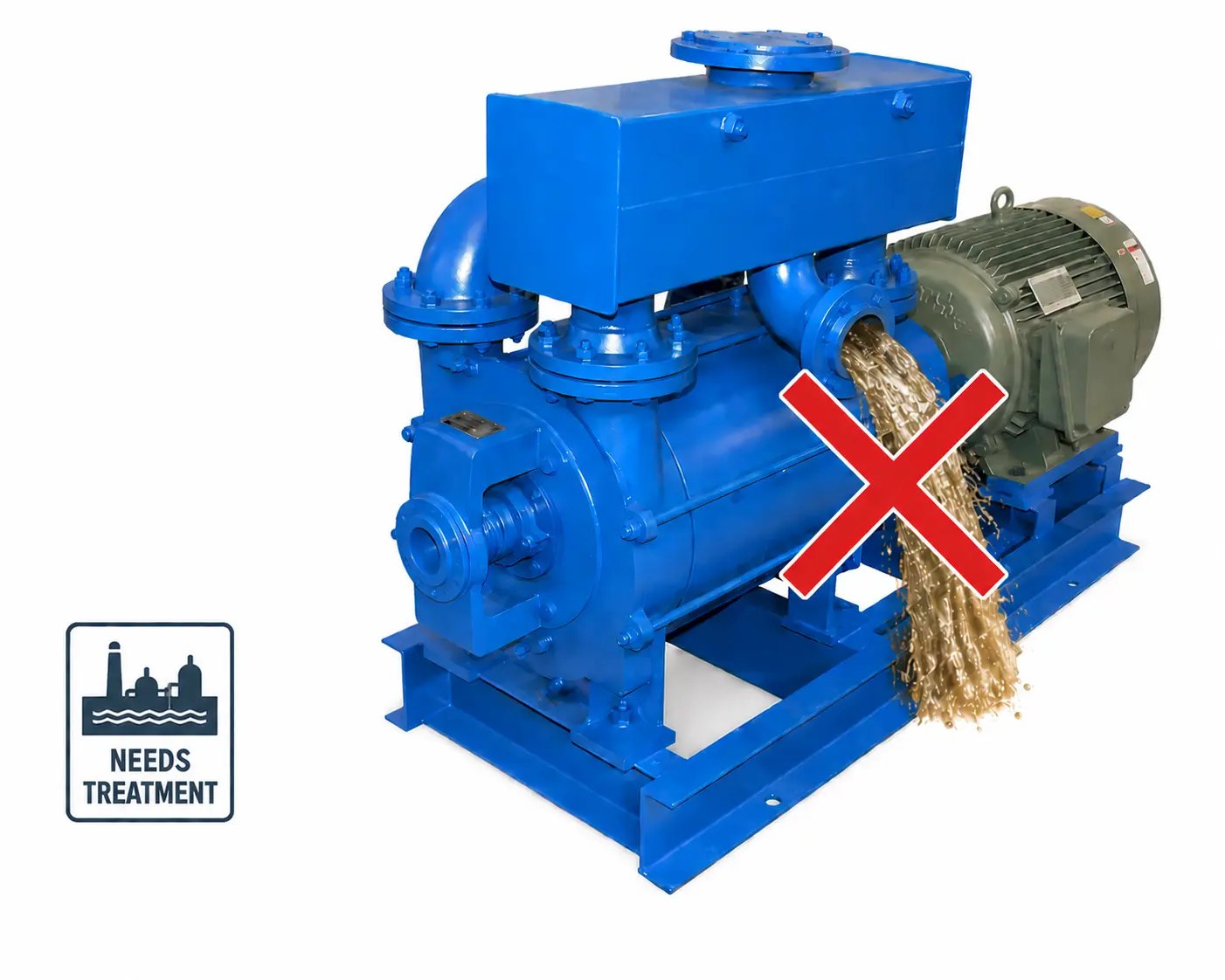
Many users assume water-sealed systems are inexpensive to operate, but that is often not true in long-term plant operation. In once-through systems, large amounts of water are continuously consumed and discharged. Even in recirculating systems with separator tanks and heat exchangers, water treatment and wastewater handling remain major operating costs.
In pharmaceutical and chemical processes, the sealing water effectively acts like a scrubber. It absorbs VOCs, acidic vapors, and solvent residue from the process gas. Over time, the recirculating water becomes increasingly contaminated and requires treatment or replacement. In some regions, wastewater treatment costs are rising faster than electricity prices.
One pharmaceutical plant I worked with in Shanghai replaced its liquid ring system with a dry screw vacuum pump mainly to reduce wastewater handling problems. The switch not only improved vacuum stability but also significantly reduced contaminated process-side wastewater generation.
Dry screw vacuum pumps can greatly reduce or eliminate process-side wastewater generation because no sealing water is used inside the compression chamberTrue
Dry screw vacuum pumps compress gas without using sealing water or other operating liquids inside the pump chamber. Because there is no liquid coming into contact with the process gas, there is no contaminated sealing water that must later be treated or discharged.
Key takeaway: In many plants, the operating cost of a liquid ring vacuum system comes not only from electricity consumption, but also from water treatment, wastewater disposal, and supporting utility systems. Dry screw vacuum pumps simplify the system by removing sealing water from the vacuum process entirely.
Scaling, Corrosion, and Frequent Maintenance
Continuous exposure to circulating water causes scaling, mineral buildup, and corrosion inside liquid ring vacuum pumps. Over time, these deposits increase internal clearances, reduce vacuum performance, and create additional maintenance work for plant operators.
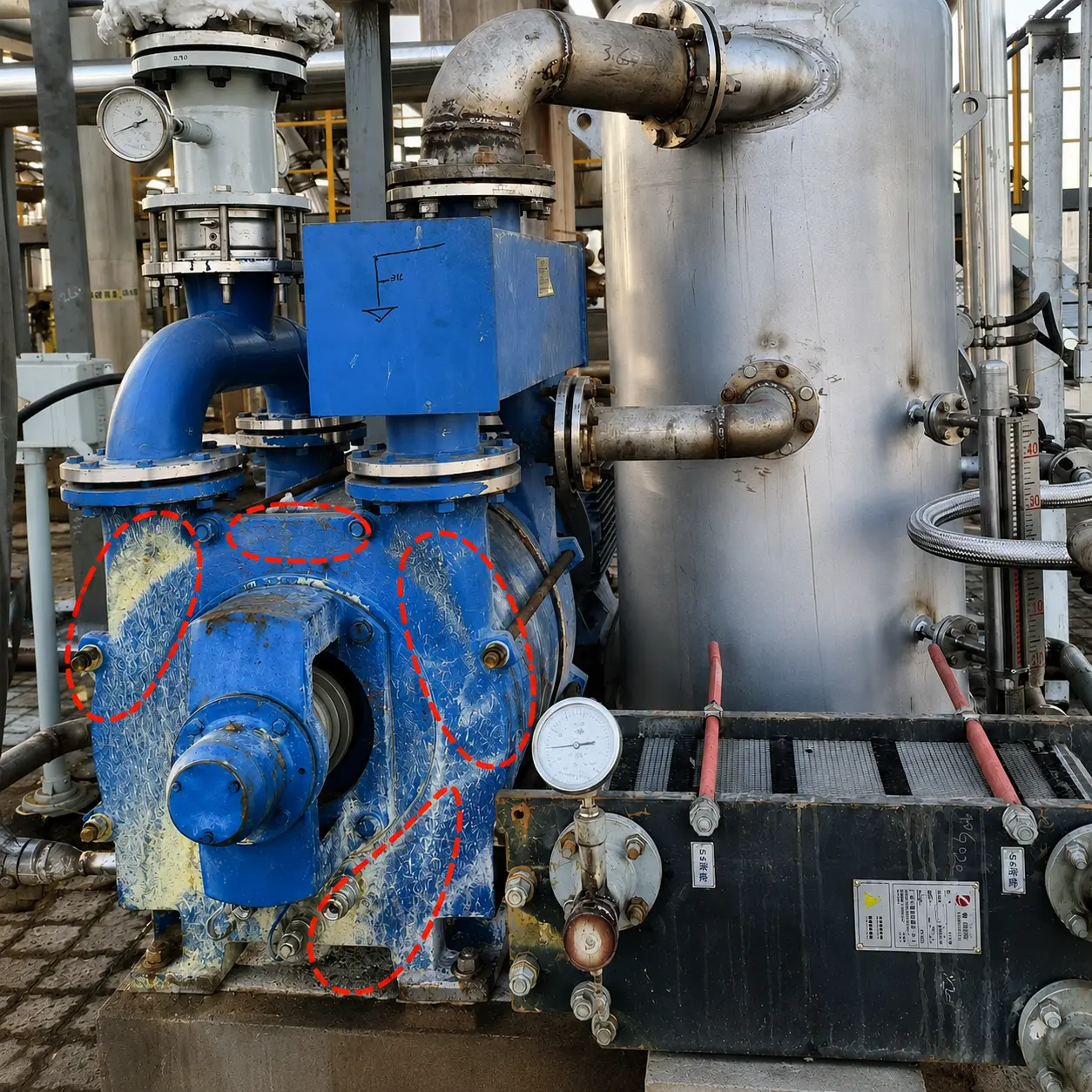
Ask almost any field technician who has serviced liquid ring vacuum systems, and they will probably mention scaling problems first. Because the sealing water is constantly circulating and partially evaporating under vacuum conditions, dissolved minerals gradually build up on the impeller and internal casing surfaces.
Once deposits become serious, vacuum performance begins to drop and cavitation damage often becomes much worse. I’ve seen impellers heavily pitted after years of operation — sometimes looking almost like Swiss cheese. In many plants, routine acid cleaning and descaling shutdowns are simply treated as part of normal maintenance.
The problem is that most modern production lines cannot tolerate frequent downtime anymore. Dry screw vacuum pumps eliminate the internal liquid ring entirely, removing one of the main causes of scaling and corrosion inside the pump. As a result, routine maintenance becomes much simpler and more predictable, usually involving gearbox oil checks, coupling inspections, and inlet filter replacement.
Routine maintenance for dry screw vacuum pumps generally requires less manual labor and fewer consumable replacements than liquid ring vacuum systemsTrue
Dry screw vacuum pumps do not use circulating sealing water inside the compression chamber, so there is no scale buildup or contaminated process water to manage. In many applications, routine maintenance is limited to gearbox oil service and periodic filter inspections.
Key takeaway: Scaling and corrosion are two of the main reasons liquid ring vacuum pumps gradually lose efficiency and require frequent maintenance. Dry screw vacuum pumps avoid many of these problems by removing sealing water from the compression process entirely.
Vacuum Performance Drops at High Sealing Water Temperatures
The achievable vacuum level of a liquid ring pump is heavily affected by the temperature of its sealing water. During summer operation, rising cooling water temperatures can significantly reduce vacuum performance and increase cavitation problems.
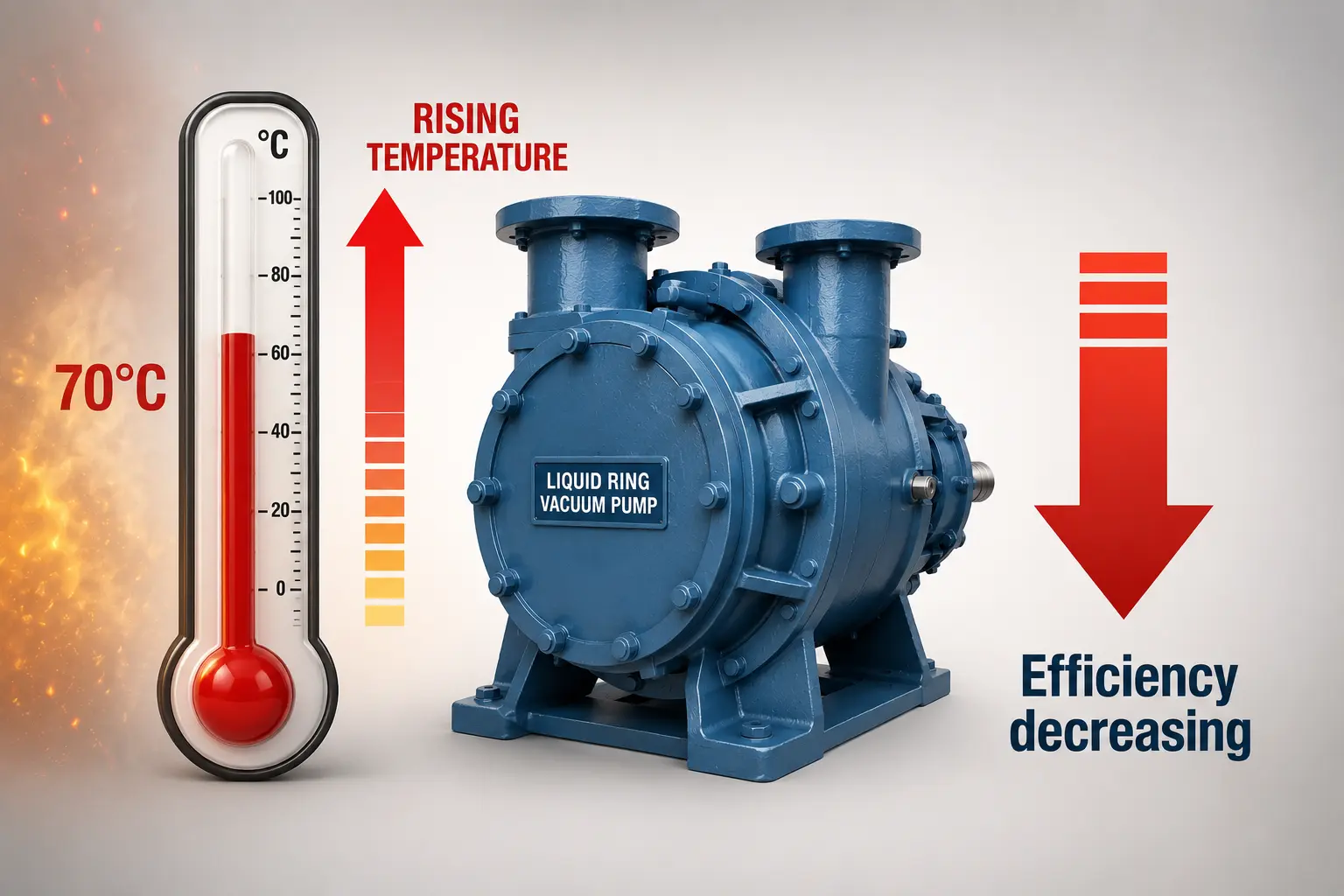
One thing many datasheets fail to emphasize is how sensitive liquid ring pumps are to cooling water conditions. If your cooling tower water reaches 30°C or higher during hot weather, the pump may struggle to maintain the same vacuum level it achieved during colder seasons.
As water temperature increases, its vapor pressure also rises. Under deep vacuum conditions, part of the sealing water can begin vaporizing inside the pump chamber. Instead of compressing process gas, the pump starts handling additional water vapor, reducing volumetric efficiency and causing unstable vacuum performance.
In drying, distillation, and filtration applications, even small vacuum fluctuations can affect product consistency and extend process times. I worked with one filtration plant where the liquid ring system constantly lost vacuum stability during the summer months. After switching to a dry screw vacuum pump, the system maintained a stable -70 kPa vacuum throughout the year, regardless of ambient temperature changes.
A liquid ring vacuum pump can maintain the same ultimate vacuum level regardless of cooling water temperature changesFalse
Liquid ring vacuum pumps are highly sensitive to sealing water temperature. As water temperature rises, vapor pressure increases, limiting the achievable vacuum level and increasing the risk of cavitation inside the pump.
Key takeaway: If your process requires stable vacuum performance throughout the year, cooling water temperature can become a major limitation for liquid ring systems. Dry screw vacuum pumps avoid this problem because they do not rely on sealing water inside the compression chamber.
Auxiliary Equipment Increases System Size and Complexity
A liquid ring vacuum system is usually much more than just the pump itself. In most installations, it also requires separator tanks, heat exchangers, cooling water piping, control valves, and drainage systems to support the sealing water loop.
Many retrofit projects underestimate how much additional equipment is required to keep a liquid ring system running properly. At first glance, the pump skid itself may seem compact, but once the separator tank, heat exchanger, cooling water lines, and drain piping are added, the overall installation footprint becomes much larger.
In some facilities, the supporting equipment for the vacuum system starts to resemble a small utility process unit of its own. More piping, valves, and instrumentation also mean more possible leak points, more maintenance work, and more components that can fail over time.
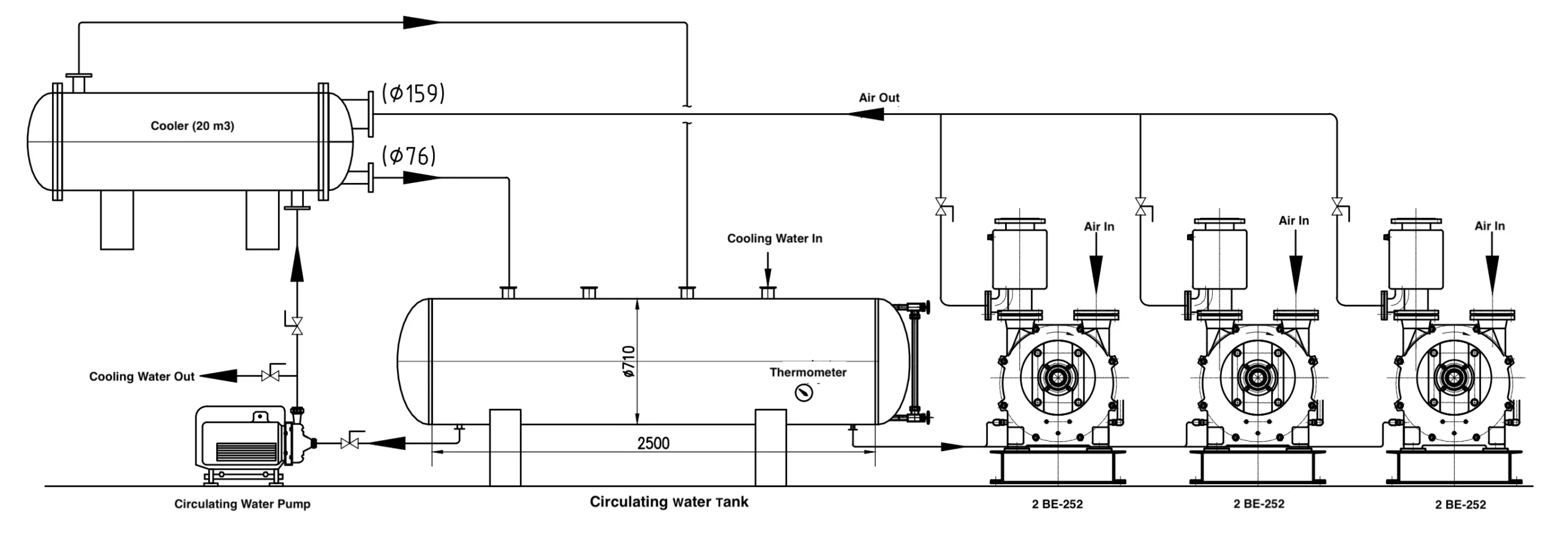
Dry screw vacuum pumps are usually much more compact because they do not require a continuous sealing water circulation system. In many cases, cooling is handled internally through air cooling or a closed-loop jacket system, significantly reducing the amount of auxiliary equipment required.
This makes dry screw systems especially attractive for retrofit projects, facility expansions, and plants where floor space is limited.
| System Component | Liquid Ring System | Dry Screw System |
|---|---|---|
| Sealing Method | Requires Continuous Sealing Water | No Sealing Liquid Required |
| Auxiliary Equipment | Separator Tanks, Heat Exchangers, Cooling Water Systems | Minimal Auxiliary Equipment |
| Installation Footprint | Large Piping Network and Support Equipment | Compact Integrated Skid |
| Common Maintenance Issues | Scaling, Valve Leaks, Water Management | Filter Replacement, Gearbox Maintenance |
Liquid ring vacuum systems generally require less floor space and simpler piping layouts than dry screw vacuum pumpsFalse
Although dry screw vacuum pumps contain internal timing gears and more complex rotor assemblies, the overall system installation is often much smaller because there is no need for large separator tanks, cooling water circulation equipment, or wastewater piping.
Key takeaway: When comparing vacuum technologies, it is important to evaluate the entire installation rather than only the pump itself. Auxiliary equipment, piping complexity, installation labor, and floor space can significantly affect the total project cost.
Conclusion: The Long-Term Cost of Vacuum Systems
When selecting vacuum equipment for a production line, focusing only on the initial purchase price can be misleading. In many cases, liquid ring vacuum pumps are less expensive to purchase upfront than dry screw systems of similar capacity.
But from a long-term operating perspective, the comparison often changes completely. Over a 5-to-7-year operating period, costs related to water consumption, wastewater treatment, cooling systems, maintenance shutdowns, and descaling labor can become far more significant than the original equipment price difference.
This is one of the main reasons many plants are replacing older liquid ring systems with dry screw vacuum pumps. Lower energy consumption, reduced maintenance requirements, and more stable vacuum performance are becoming increasingly important in modern manufacturing environments.
If your facility is dealing with unstable summer vacuum levels, rising wastewater treatment costs, or frequent seal maintenance, it may be worth reviewing the overall operating cost of your current vacuum system.
Feel free to reach out with your process conditions, operating pressure range, gas composition, and current utility consumption. I’d be happy to help you compare the real long-term operating costs and evaluate whether a dry screw upgrade makes sense for your application.