
Filtration and Dewatering - Customer-site case study
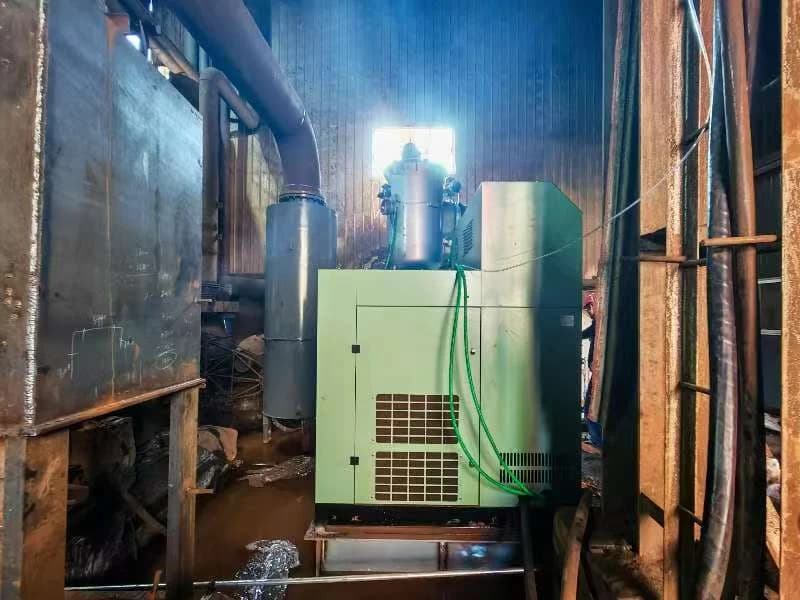
TF273L dry screw vacuum pump for iron ore dewatering
An iron ore company in Tangshan, Hebei, China tested TF273L as the dry screw vacuum pump reference for an iron ore dewatering line. The work started with an energy-saving request and became a customer-site test around wet carryover, non-corrosive liquid, and actual production-line vacuum demand.
Operating point
210 m3/min
customer required volumetric flow rate at 25000 Pa(a)
Location
Tangshan, Hebei, China
Model reference
TF273L dry screw vacuum pump
Previous pump
2BEC-42 water ring vacuum pump
Site test result
One TF273L supported three production lines
Project background
The project began with a power-consumption target. An iron ore company in Hebei wanted its dewatering line to use less electricity as China moved further toward carbon neutrality. SC Air Power Tech then proposed a joint test with the disc dewatering equipment manufacturer that supplied the line.
Vacuum duty in the process
On this dewatering line, the vacuum pump is not only used for a short drawdown. After loading, the process has to keep its working vacuum until the next loading step. The same vacuum also pulls liquid through the filter media, so the pump package has to be reviewed around moisture, liquid carryover, and any solids that may be carried with it. This is the same application direction covered on our filtration and dewatering vacuum pump page.
Stable holding vacuum
After loading, the dewatering line has to hold its working vacuum steady until the next loading step.
Wet carryover
Liquid carryover was expected on the vacuum side. For this project, the liquid was checked before testing and confirmed as non-corrosive.
Solids protection
Solid particles could move with the wet carryover, so the package used a gas-liquid separator and an inlet filter before the pump chamber.
Existing system challenge
The original process used a 2BEC-42 water ring vacuum pump. During earlier cooperation with other dry screw vacuum pump suppliers, the dewatering equipment manufacturer kept running into the same limitation: those pumps were not intended to accept liquid entering the pump chamber. SC approached the duty differently. We reviewed the pump package for wet carryover into the working chamber, after checking the liquid condition and protection details.
For this project, the carried liquid was confirmed as non-corrosive. With that point settled, TF273L could be installed at the iron ore site for the dewatering test.
SC test setup
TF273L was used as the test model. The customer required operating point was 210 m3/min at 25000 Pa(a). Before the test, the disc dewatering equipment manufacturer expected one TF273L to support one production line, based on calculations from the previous water ring pump parameters.
| Model reference | TF273L |
|---|---|
| Customer required operating point | 210 m3/min at 25000 Pa(a) |
| Application | Iron ore filtration and dewatering |
| Previous pump | 2BEC-42 water ring vacuum pump |
| Liquid condition | Liquid carryover reviewed and confirmed as non-corrosive for this project |
| Configuration review | Wet carryover into the working chamber, separator layout, inlet filtration, drainage, leakage, and operating duty |
Verified result
The site test changed the sizing discussion. The original estimate was higher than the actual vacuum demand, and one TF273L dry screw vacuum pump supported three production lines. With all three lines connected, the measured power consumption was 120 kW.
For comparison, the previous 2BEC-42 water ring vacuum pump required 160 kW to support one production line. The figures gave the customer a practical energy comparison for this plant and helped frame later expansion planning.
| Tested SC setup | One TF273L supporting three production lines |
|---|---|
| TF273L power consumption | 120 kW with three production lines connected |
| Previous water ring setup | One 2BEC-42 water ring vacuum pump supporting one production line |
| Previous power consumption | 160 kW for one production line |
| One-month customer report | Approximately 60% reduction in power consumption compared with the previous water ring vacuum pump system |
| Customer savings estimate | Approximately RMB 400,000 in the first year after procurement cost, then about RMB 970,000 per year |
What this test changed in the review
This project changed two parts of the review. First, the existing water ring pump data gave a conservative starting point, but the site load still had to be checked under production conditions. Second, wet carryover could be accepted only after the liquid condition, gas-liquid separator, inlet filter, and drainage details were reviewed together.